STAT 550
Advanced Mathematical Statistics
Advanced Mathematical Statistics
Spring 2026 Syllabus
Course calendar and content
See our course calendar for course deadlines and material covered each week. Course content will be available in our Canvas page.
Course description and learning outcomes
STAT 550 is a course in the theory of advanced mathematical statistics, examining topics such as sufficiency, completeness, ancillary statistics, invariance, likelihood-based inference, large sample theory, and Edgeworth and saddlepoint approximations. By the end of this course, the successful student should be able to:
- Use rigorous mathematical techniques to derive mathematical
statistics results, including construction of hypothesis tests and
confidence intervals,
- Describe and program optimization algorithms used in
estimation,
- Compare and contrast different statistical inference approaches
based on principles of mathematical statistics,
- Derive asymptotic distributions and properties of statistics, and
- Communicate summaries of journal articles on mathematical statistics topics, both written and oral.
Time and location
Tue/Thur 9:25am-10:40am Wilson Hall 1-128
Instructor contact information
Dr. Stacey Hancock
email: stacey.hancock@montana.edu
Office: Wilson 2-195
Phone: (406) 993-5350
Office hours:
- Monday 1-2pm
- Tuesday 8:15-9:15am
- Thursday 8:15-9:15am
- Also available by appointment.
Prerequisites
STAT 502 and either M 384, M 505, M547 or equivalent. This course assumes working knowledge of linear algebra, multivariate calculus, infinite series, and methods of proof.
Course materials
Textbook
The required textbooks for the course are available in pdf form in our Canvas page:
- Robert J. Boik’s STAT 550 Lecture Notes
- Robert J. Boik’s STAT 505 Lecture Notes
Journal articles and chapters from various books will also be used. See the beginning of the STAT 550 Lecture Notes for a course outline.
You will be allowed to use these textbooks on each quiz/exam, but not electronically, so please print a copy of the relevant textbook pages to use for each quiz/exam. I recommend purchasing a three-ring binder for the printed pages, or have the textbooks printed and spiral bound at a local printing shop.
Statistical computing
We will be using the statistical software R through the IDE RStudio. I will assume basic familiarity with this programming language. Students have four options for accessing this free software:
Download to your own laptop. (Note R and RStudio will not run on iPad, notebooks, or Chromebooks. If you have one of these devices, see the cloud-based option below.)
- Download and install R.
- Download and install RStudio Desktop.
Use RStudio through the Posit Cloud. This resource allows you to use RStudio through a web browser. It is free for use, but it does limit you to a certain number of project hours per month.
Use RStudio through an MSU virtual machine.
Use RStudio in an MSU on-campus computer lab.
Learning management
- Canvas:
Announcements, gradebook, discussion forums.
- Important: Make sure you are receiving email notifications for any Canvas activity. In Canvas, click Account on the top left, then Notifications. Check that Canvas is using an email address that you regularly check (if not, change your Canvas Contact email by clicking on Account, then Settings). Check the boxes to get notifications for Course Content, Files, Announcement, Grading, and Discussions.
- If you have a question about the course materials, computing, or logistics, please post your question to your Canvas discussion board instead of emailing your instructor. This ensures all students can benefit from the responses. Other students are encouraged to respond.
- We will not be using a learning management system for homework and quizzes; homework and quizzes will be turned in at the beginning of class, and graded homeworks/quizzes will be either returned in class or in your department mailbox.
Course expectations
In this course, you are expected to have professional behavior. You are expected to attend all class meetings on time, be curious, ask questions, seek opportunities to learn, and be open and responsive to constructive feedback. In addition:
- Be an active participant—statistics is not a spectator sport!
- Be committed, take your work seriously.
- Engage with the in-class activities and homework sets.
- Help others—if you understand the material being discussed, practice your mentoring skills. This does not mean sharing answers, but instead helping others understand the concepts.
- Complete assigned readings and read your textbooks.
You are also expected to exhibit a professional demeanor (language, attitude) toward others. Disagreement during discussions is welcome and often productive in developing a deeper understanding of the concepts being discussed. However, disagreement in a discussion does not warrant yelling or disrespectful language or behavior. Unprofessional behavior that impedes on other students’ opportunity to learn will not be tolerated, and appropriate actions will be taken to prevent future occurrences. Anyone causing minor disturbances (e.g., cell phone usage or ringing) will be expected to bring treats for everyone else to the next class meeting.
Course assessment
Your grade in STAT 550 will contain the following components.
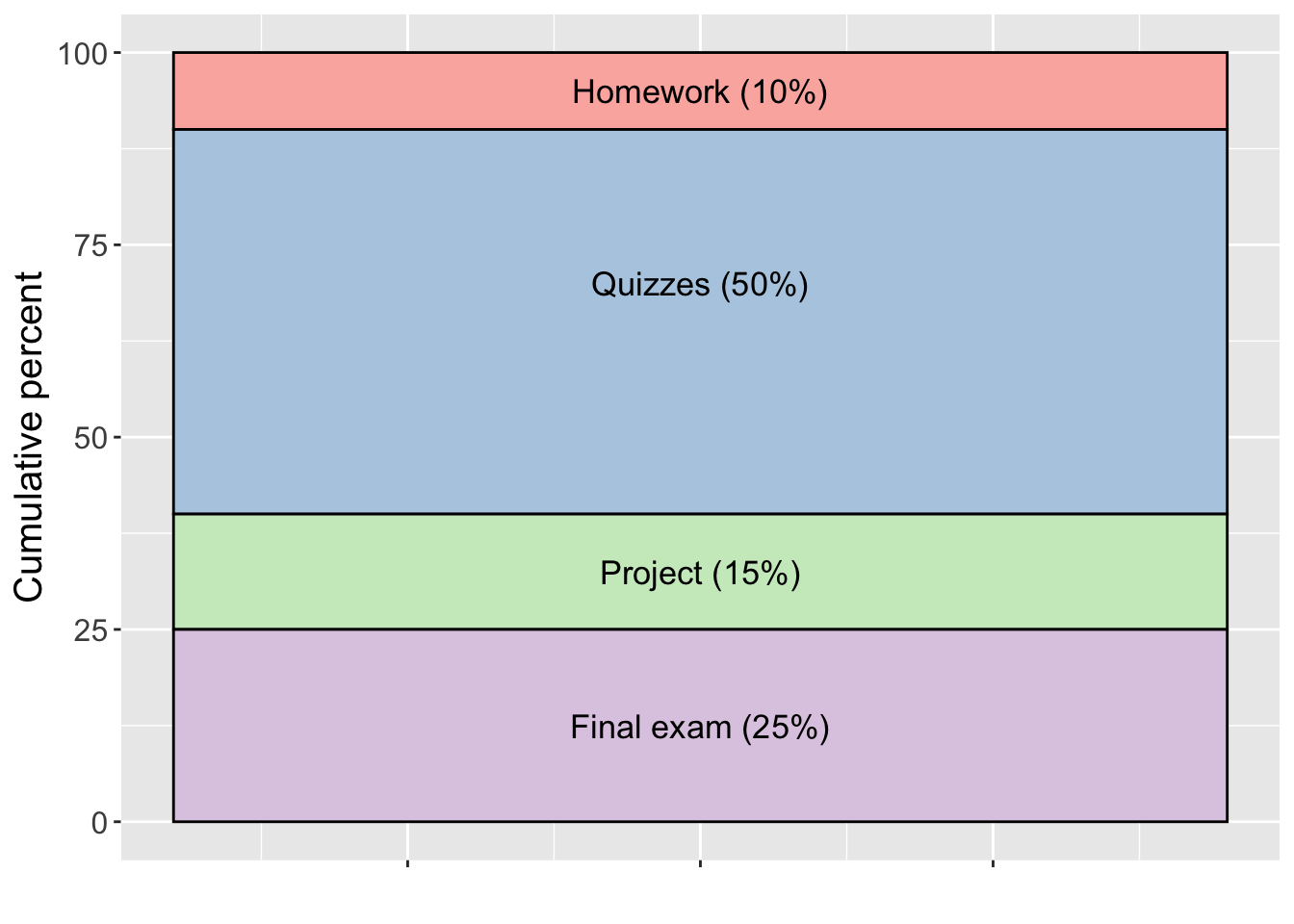
- Homework (10%): The only way to learn probability
and statistics is to practice working and re-working problems, and
homework is therefore an essential part of the course.
- Homework will be assigned approximately weekly.
- Homework problems are graded as P, F, or re-do. Re-do problems must be completed within one week after graded homework is returned. Your original homework must be turned in with your re-do work.
- Late homework should be avoided in all but the most dire emergencies. In the event of extreme circumstances, other arrangements will be considered if prior notification is provided.
- See the policy on collaboration and academic misconduct section for guidance with regards to collaboration on homework assignments.
- All but one homework must be passed by the last day of classes to earn a passing grade in STAT 550 (that is, one homework may be dropped).
- Quizzes (50%): In-class quizzes (~40 min) will
occur approximately every three weeks.
- Quizzes are open book and open notes, but the textbook and notes must be printed. (No electronic devices allowed).
- The lowest quiz score will be dropped.
- Project (15%): Each student will dive into one mathematical statistics journal article of your choice this semester. The project will include a written “executive summary”, a proof sketch of one of the derivations in the article, and an 10-12 minute presentation of the article during the last week of classes. Detailed project instructions and deadlines will be available in Canvas.
- Final exam (25%): Our final exam will be on Tuesday, May 5, 8:00am-9:50am in our same classroom.
Letter grades generally follow the typical scale:
93-100 = A
90-92 = A-
88-89 = B+
83-87 = B
80-82 = B-
etc.
These cutoffs may be adjusted down (never up!) at the end of the semester, depending on the grade distribution in the course. Thus, a 93% will guarantee an A, a 90% will guarantee an A-, etc.
Diversity and inclusivity statements
Respect for Diversity: It is our intent that students from all diverse backgrounds and perspectives be well-served by this course, that students’ learning needs be addressed both in and out of class, and that the diversity that students bring to this class be viewed as a resource, strength and benefit. It is our intent to present materials and activities that are respectful of diversity: gender identity, sexual orientation, disability, age, socioeconomic status, ethnicity, race, religion, culture, perspective, and other background characteristics. Your suggestions about how to improve the value of diversity in this course are encouraged and appreciated. Please let us know ways to improve the effectiveness of the course for you personally or for other students or student groups.
In addition, in scheduling exams, we have attempted to avoid conflicts with major religious holidays. If, however, we have inadvertently scheduled an exam or major deadline that creates a conflict with your religious observances, please let us know as soon as possible so that we can make other arrangements.
Support for Inclusivity: We support an inclusive learning environment where diversity and individual differences are understood, respected, appreciated, and recognized as a source of strength. We expect that students, faculty, administrators and staff at MSU will respect differences and demonstrate diligence in understanding how other peoples’ perspectives, behaviors, and worldviews may be different from their own.
Policy on the use of generative AI
This class will strive to create an environment that fosters learning, critical thinking, and effective communication. To achieve these goals, I have decided to prohibit the use of ChatGPT or similar tools during this course, with the exception of assistance in writing computer code.
While ChatGPT and other language models can be powerful and useful tools in certain contexts, I believe that relying on them for this course undermines the learning objectives. I want you to develop your skills in independent thinking, problem-solving, and engagement with the subject matter. By restricting the use of AI language models to help with coding only, you will utilize your knowledge, creativity, and critical analysis to complete your assignments and actively participate in class discussions.
I understand that technology plays an increasingly prominent role in various aspects of our lives, and I acknowledge its potential benefits. However, in the context of this course, I believe that relying on personal effort and intellectual exploration will enhance your learning experience and contribute to your long-term development as a knowledgeable and well-rounded individual.
It is important to note that this requirement applies to all aspects of the course, including assignments, exams, and any form of communication related to the course content. Any use of AI language models, including ChatGPT, during these activities, outside of appropriate use to aid in computer coding, will be considered a violation of the student code of conduct.
Should you have any questions or concerns regarding this course expectation, please feel free to discuss them with me. I am here to support and guide you throughout this educational journey.
The wording above was adapted from MSU’s guidance on establishing expectations, syllabus language, and policies for generative AI use.
Policy on collaboration and academic misconduct
At a minimum, any act of academic dishonesty, which includes but is not limited to plagiarism, cheating, multiple submissions, or facilitating others’ misconduct, will result in a score of zero on the assignment/quiz/exam in question and notification of department and university officials. Further action may be taken as warranted. If you have any questions about the limits of collaboration or about using and citing sources, you are expected to ask for clarification.
Homework
After attempting to complete homework problems on your own, you are permitted to collaborate on homework in a constructive manner for all involved—each individual in the collaboration needs to ensure they understand and could explain the process of solving each problem. While I encourage you to talk through problems with fellow students, the work you turn in must be your own and must be written in your own words (unless the assignment specifically states otherwise).
Each homework will you to cite all sources (including web forums such as Stack Overflow, Google searches, and AI (for coding questions only)) and individuals used to complete that homework assignment. Paraphrasing or quoting another’s work without citing the source is a form of academic dishonesty. Even inadvertent or unintentional misuse or appropriation of another’s work (such as relying heavily on source material that is not expressly acknowledged) is considered plagiarism. Homework assignments that do not cite sources or individuals, or assignments where answers are copied directly from another student, will be considered and treated as plagiarism, and will receive a zero grade. If you have any questions about the limits of collaboration or about using and citing sources, you are expected to ask for clarification.
MSU policy
Students in an academic setting are responsible for approaching all assignments with rigor, integrity, and in compliance with the University Code of Student Conduct. This responsibility includes:
- consulting and analyzing sources that are relevant to the topic of inquiry;
- clearly acknowledging when they draw from the ideas or the phrasing of those sources in their own writing;
- learning and using appropriate citation conventions within the field in which they are studying; and
- asking their instructor for guidance when they are uncertain of how to acknowledge the contributions of others in their thinking and writing.
More information about Student Conduct from the Dean of Students